For K–12 Superintendents, District Leaders, and Executive Directors

Your people are capable. Your system isn't set up to prove it.

Most districts don't have a people problem. They have a system problem — unclear roles, unaddressed conversations, and leadership development that fades the moment the facilitator leaves the building.

We install the operating system that fixes it. Measurably.

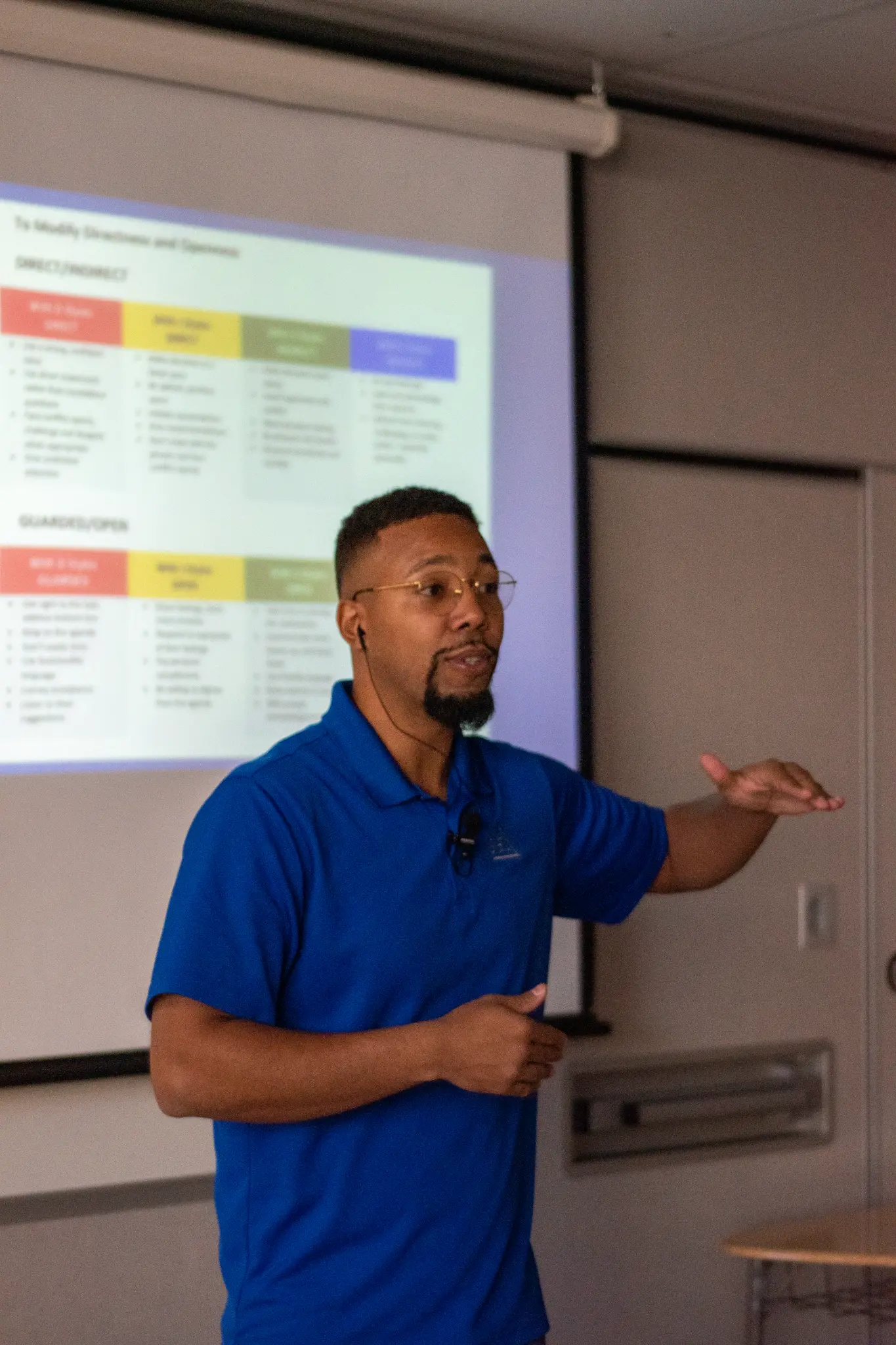
Tre' Gammage leading a leadership system session

The Real Cost of a Broken System (And Who Actually Pays)

Districts don't stall from incompetence. They stall from a system that was never built.

01

The Staff Member

A teacher is hired to teach. Then they're asked to lead PLCs, handle trauma, manage parent conflict, facilitate SEL, analyze data, and mentor peers — with no training, no decision authority, and no one to escalate to. When they burn out, the system calls it “not a good fit.” That's not a fit problem. That's a system that outsourced its failure to a human body.

02

The Leader

A principal inherits a Commendable school, watches it slide to Comprehensive, and gets told to “turn it around” with the same staffing, same budget, and no operating system. When the numbers don't move, their career takes the hit — not the district's design.

03

The Student

Graduate Arkansas: testing participation moved from 35% to 95% — a 60-point jump — after staff stopped running on rumor cycles and started running on a decision matrix. Students don't take tests they don't trust the system to honor. That number moved because the adults got organized.

04

The Community

Every teacher who quits takes $16K–$25K of taxpayer-funded training, hiring, and onboarding cost with them — before counting classroom disruption, lost institutional knowledge, or the culture tax on teammates who stay. The public absorbs the cost of churn and never sees the invoice.

What Happens If Nothing Changes

Year 1–3

Turnover spikes. Best staff leave first. Remaining staff learn that silence is safer than feedback. Culture hardens around “just survive.”

Institutional knowledge walks out with every departure. New hires inherit dysfunction as normal.

Year 3–5

Leadership pipelines dry up. The people who should become principals watched what it cost the last one — and opt out.

Districts start hiring for availability, not capability. The system begins selecting for risk-aversion and against the operators who could fix it.

Year 5–10

Student outcomes decline in ways that look like “the kids changed” — but are actually the compounding of adult instability.

Communities lose trust in public education. Enrollment shifts to charters and private schools, draining funding from the schools that need it most.

"We are good people doing hard work in a broken system, and no one has given us the operating system to lead it well."

The System Was Built in the Field, Not a Conference Room.

Nine years. 44 organizations. One consistent system.

The original system was installed at 101 Docs Drive, Bishopville, South Carolina — a rural K–12 charter school in South Carolina's Corridor of Opportunity. Not a pilot. Not a workshop. A nine-year engagement where Tre Gammage walked the halls, observed classrooms, subbed during COVID, ran PBIS, and built every solution from evidence, not assumptions.

That school now holds a 96% graduation rate — nine points above the state average — with three consecutive graduating classes at 100% college and career readiness. It was the first proof case. It became the blueprint.

Since then, the system has been refined across 44 organizations — K–12 districts, nonprofits, and mission-driven teams. Every engagement sharpened the framework. The result is a Leadership Operating System that doesn't depend on the facilitator being in the room. Where others focus on inspiration, we focus on infrastructure. Where workshops fade, our structures hold.

1,500+

Leaders trained through the Everyday Strengths curriculum

44

Organizations served since 2017

600+

Training engagements delivered (MTSS, SEL, and strengths)

96%

Lifetime client satisfaction

70%

Multi-year client continuation rate

+10%

Average pre/post gain — well-being, role confidence, strengths usage

600+ engagements include 175 MTSS sessions with Panorama Education, 300+ SEL sessions with 7 Mindsets, and 100+ direct strengths training sessions across 44 organizations.

See Full Results

How the System Gets Installed

Four phases. One operating system. Documented proof at every stage.

PHASE 1

ASSESS

  • DISC + EQ assessments for all participants.
  • Onboarding survey.
  • Team composition analysis.
  • Onboarding call with leaders.
  • You see exactly where the gaps are before we build anything.

PHASE 2

ALIGN

  • Align roles and decisions through initial assessment debrief.
  • Relationships + Communication kick-off session.
  • Your team stops guessing and starts leading by design.

PHASE 3

ACTIVATE

  • The system goes to work.
  • Alignment work from the assessment debrief gives us additional feedback to refine the annual development plan.
  • Development cadence.
  • Leadership Advisory.
  • Coaching Cycles.

PHASE 4

SUSTAIN

  • Check-ins. Data.
  • Biweekly coaching.
  • Leader-led progress reviews.
  • Pre/post benchmarking.
  • End-of-engagement case study your team keeps.
  • The system holds after we leave.

What the System Produces — Across Sectors

The evidence base spans K–12, nonprofits, and mission-driven organizations.

Pee Dee Math Science & Technology Academy

Rural K–12 Charter · SC · 9-Year Engagement

  • 96% graduation rate (4-yr avg: 95.28%)
  • 9 pts above SC state average
  • $8.4M in scholarships — 37 graduates, 141 acceptances
  • 100% college & career ready — 3 consecutive classes
  • First WECO-certified school in SC Public Charter District

Whittier Primary School

K–12 · Multi-Year Engagement

  • +16.6% staff well-being (pre/post)
  • 10-person pilot → full staff in 30 days
  • Designation risk arrested
  • Continued to Year 3 contract

Graduate Arkansas

Alternative High School · Year 1–2

  • +20.3% strengths awareness (61.1% → 81.4%)
  • Testing participation 35% → 95%
  • Leadership transition stabilized

Native Renewables

Solar Non-Profit · Active Engagement

  • 91% strengths-applied rate
  • 86.3% overall satisfaction
  • Team shifted from over-planning to visible, assertive leadership without breaking trust dynamics

City of South Bend Venues Parks & Arts

Municipal Organization · Active Engagement

  • +9% Well-Being
  • +4.8% Increased Role Clarity
  • 90-Day Role Clarity Initiative
  • 30-Day Relationships + Communication Sprint

OPS School Psychology

K–12 · District Department

  • +14.8% strengths awareness (69.3% → 84.1%)
  • 84.9% post-training application confidence
  • Pre/post documented

What's Actually at Stake

Two versions of next year. You choose which one.

Without a System

  • Same staff exits. Same $16K–$25K per departure
  • Another year of 'we talked about culture'
  • Implementation drift on your strategic plan
  • Nothing documented for the board or funders
  • Your best people leave first. Because they have options.

With the System

  • Staff stay. Culture holds. You can prove it with data
  • Leaders lead by design, not personality
  • Pre/post benchmarking for any board or funder
  • A case study from your own district — not someone else's

Start Here — It's Free

Get your free Strengths & Communication Profile.

In 5 minutes, you'll know your DISC behavioral style, your primary communication pattern, and where your team's biggest alignment gaps are likely hiding.

What happens after you submit:

  1. 1. Instant: You receive your free Strengths & Communication Profile (mini DISC report, 8 pages)
  2. 2. Follow-up: We'll email you with instructions and next steps!

Ready to Install the System?

Start with a 30-minute Problem Call.

We map exactly where your leadership system breaks down — and what it would take to fix it. You leave with clarity whether we work together or not.

This call is with Tre directly. 30 minutes.

Book Your Problem Call →